
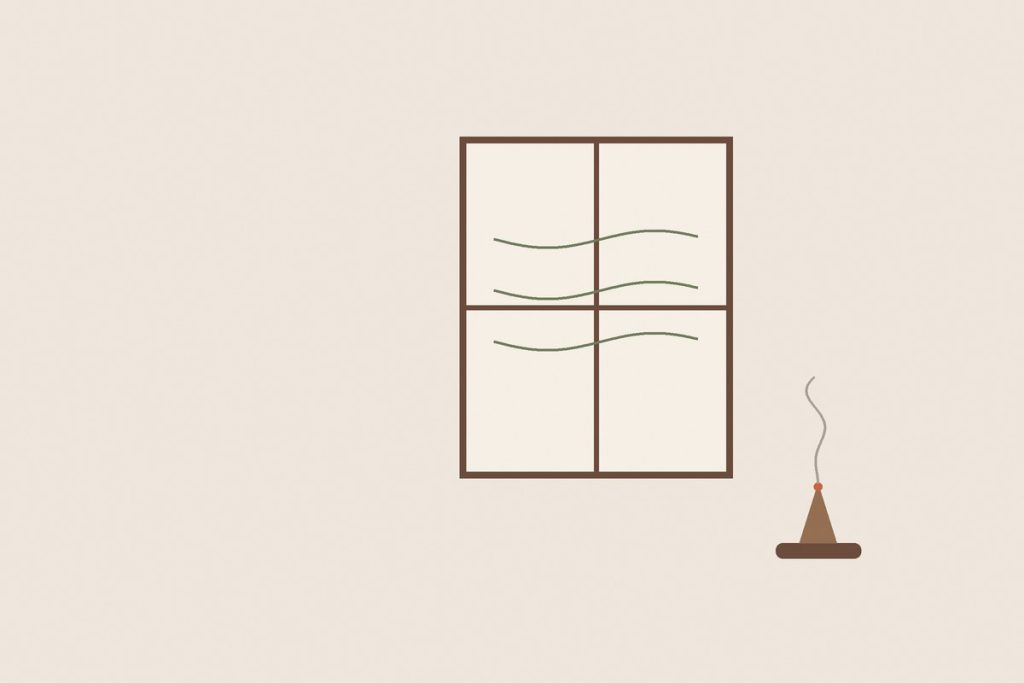
All incense smoke, however natural the ingredients, comes from combustion and contains fine particles. The simplest and most effective way to reduce smoke at home is good ventilation when burning incense: open a window, burn in moderation and place the incense where air can move.
This guide is not meant to worry you. It is meant to help you enjoy incense with a clear head: why ventilation matters and how to do it well.
What is in incense smoke
When any organic material smoulders, from wood to leaves to tobacco, it creates a mixture of gases and tiny particles. A 2022 scientific review by Yadav and colleagues in the Journal of Inflammation Research gathers many studies on incense smoke and reports that burning incense releases particulate matter (PM), volatile organic compounds and gases such as carbon monoxide. The authors argue that repeated exposure, especially in enclosed spaces, deserves attention. You can read the abstract of the review for more detail.
It is worth stating the limits. This is a review, and many of the studies in it look at heavy, long-hours burning such as in temples or homes that burn daily, not an occasional cone in an airy room. The level of risk depends on how much is burned, for how long, in what space, and on each person’s health. But the practical message is clear: moving air thins the smoke.
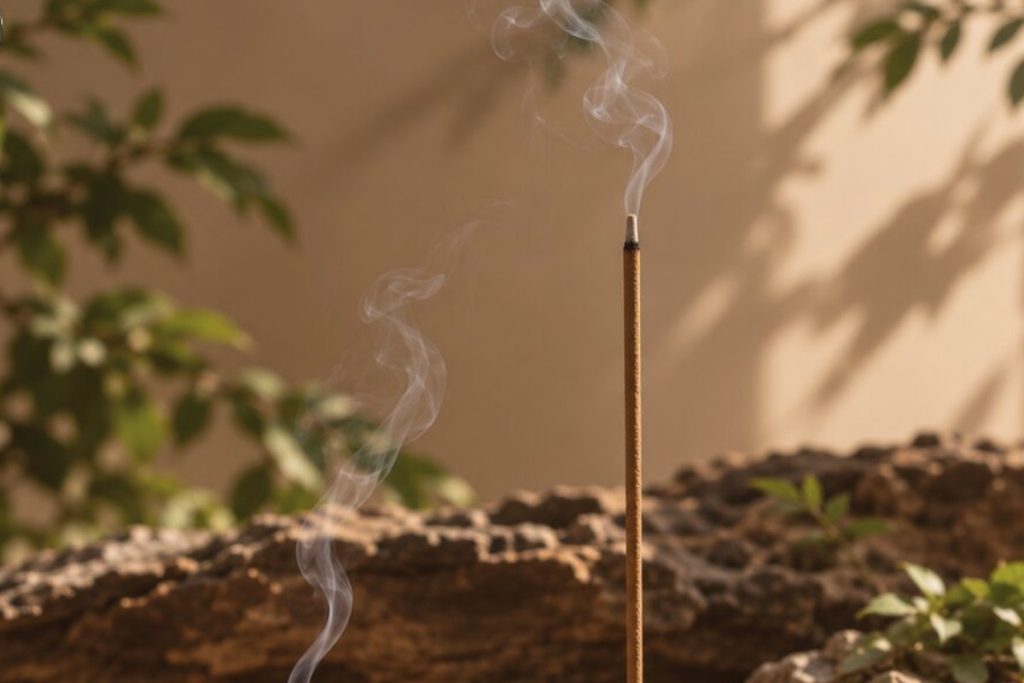
Ventilation when burning incense: simple habits
- Open a window while burning. Even a small gap helps, and two openings on opposite sides, so air moves gently, is better.
- Burn in a larger room with a high ceiling. Smoke concentrates faster in small, tight rooms.
- One cone at a time. Several at once raise the amount of smoke quickly.
- Do not sit right beside the smoke. Keep at least an arm’s length, and put the incense on the side where air flows out.
- Never burn while asleep or away. For fire safety as well as because smoke builds up.
- Leave the window open a while after the cone is out. Let leftover smoke clear before you close up.
A few small details are worth remembering. First, a cone usually burns for around fifteen to twenty-five minutes, so you do not need to burn all evening; treat a cone as a timer for a short pause. Second, avoid placing incense right under a fan or air conditioner, since a strong draught spreads smoke across the room instead of carrying it out. Third, if someone is asleep or unwell at home, burn in a corner far from them, or on a balcony or porch.
If your space is small, read more about incense for a small apartment or studio and how incense smoke moves through a room.
Does an air purifier help?
Air purifiers with HEPA filters are commonly used to reduce fine particles indoors, and many studies of indoor air quality discuss their effect on particles. They are a useful supplement, especially when you cannot open windows much, in a polluted city or on a cold day. But a purifier does not replace ventilation: it brings in no fresh air, and its effect depends on room size, capacity and replacing the filter on time.
If you use one, choose a unit suited to your room’s size, keep it unobstructed and change the filter as the maker recommends.
When to cut back or stop
Put the incense out and open the windows if you notice stinging eyes, coughing, a dry throat, headache or any difficulty breathing. Everyone is sensitive in different ways, and your own symptoms are more reliable than any rule. For people with respiratory conditions such as asthma, older adults, pregnant women and households with small children, please ask a doctor first, and favour burning less, further away, or not in shared living rooms.
This is not personal medical advice, only the usual sensible precautions.
For sensitive lungs, see our note on incense smoke and sensitive lungs.
Ventilation and slow living
Here is something nice: opening the window does not take away the calm of a session. Many people find that the sound of wind, the light outside and the smell of the afternoon become part of the experience. Incense needs air to burn, and we need air to breathe. Both need room.
At Yūgen we choose plant-based materials and keep recipes simple, but we do not claim that incense smoke is harmless. What we believe in is burning with awareness: just enough, airy and unhurried. If you are looking for cones to begin with, see the shop or try the scent finder.
FAQ
Do I need to open a window when burning incense?
Yes, it helps. Even a small gap works, and two openings on opposite sides are better because air moves gently through the room and the smoke thins out. Keep the window open a while after the incense goes out so any leftover smoke can leave.
Can an air purifier replace an open window?
No. A HEPA purifier can help reduce fine particles, but it does not bring in fresh air, and its effect depends on room size, capacity and timely filter changes.
How many cones should I burn at once?
One at a time is enough. A cone usually burns for about fifteen to twenty-five minutes, so there is no need to burn them all evening, and several cones at once raise the amount of smoke quickly.
An open window is the first part of a good incense session.