Incense cone colour usually comes from its ingredients: the deep brown of agarwood, the warm reddish brown of cinnamon, the greyish brown of vetiver root. So two boxes of cones in different colours do not mean one is “good” and the other “bad”. What deserves a little caution is colour that is too bright and too even, since that can point to dyes.
This guide shows how to read colour as a small clue about ingredients, not as an absolute test.
Where incense cone colour comes from
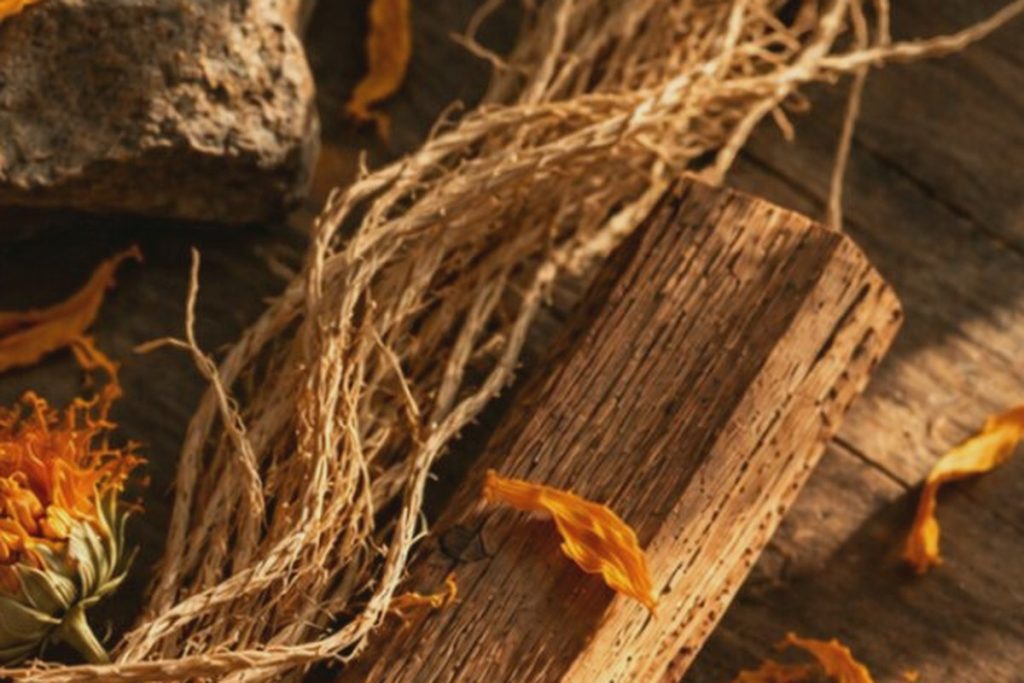
Once dry materials are ground, their colour shows clearly. Agarwood powder is usually dark brown, sometimes nearly black where the resin is rich. Cinnamon turns a warm reddish brown. Vetiver, the grass root known as hương bài, gives a soft greyish brown. Star anise leans golden brown. Dried leaves and flowers such as mugwort, marigold or jasmine are paler, sometimes with a hint of olive green. Blend several together and the result is usually a family of earthy browns. The binder also shapes the look, see natural binders in incense cones.
Colour also shifts with harvest season, the age of the wood, how it was dried and how finely it was milled. The same recipe made in two batches may differ slightly in shade. For handmade incense that is normal, and even a sign of honesty.
Why some cones are much darker
A nearly black cone is not necessarily dyed. Three common reasons can be entirely natural:
- Rich resin and oil: agarwood and other oily woods give darker powder.
- Charcoal: some recipes use wood charcoal as a burning base. It turns the cone black, and it should be named on the label.
- Moisture while drying: a cone not fully dry, or one just taken out of damp air, can look darker at first and lighten over time.
Light-coloured cones, by contrast, often contain more leaves, flowers or pale woods such as sandalwood.
When to be wary of very bright colours
Dried herbs and woods rarely give bright red, neon green or deep purple. If a cone is vividly saturated and so even that it looks like a sweet, it almost certainly contains a colourant. That could be plant-based, such as turmeric or butterfly pea flower, or it could be an industrial dye. For ingredients in detail, see reading an incense ingredient label.
We do not want to claim that every colourant is harmful, because that depends on the specific substance and amount. But everything in a cone ends up in the smoke, so a sensible rule of thumb is to prefer cones whose maker can tell you where the colour comes from. A transparent brand will answer that question.
You will also meet traditional red-dyed sticks, as in the incense villages of northern Vietnam, where the bamboo is dyed and then dried in the sun. That is part of the craft’s culture. Still, if you burn often in a closed room, choosing products that state their colourants is reasonable.
Reading colour like a careful shopper
- Match colour to the scent name. An “agarwood” cone that is chalk white, or a “cinnamon” cone that is leaf green, is worth a question.
- Snap or lightly scrape a corner. A naturally made cone is usually the same colour inside as outside, with no coating.
- Check your fingertips. If bright colour rubs off after holding it, think twice.
- Read the label. Words like “colourant” or a colour code mean the maker is hiding nothing.
- Trust your nose. A harsh smell that stings your eyes as soon as it is lit is reason enough to stop.
Colour is only one clue, never the only proof. Plenty of plain-looking cones use poor materials, and the reverse is true too.
The colours of Yūgen
Our cones come in browns, reddish browns and greyish browns, varying gently across the four scent groups: Woody, Herbal, Agarwood and Soft & sweet. We do not brighten them to catch the eye, because what we hope you notice is the calm of the material itself. The familiar reddish brown of cinnamon is in cinnamon: the scent of warmth.
If you would like to look at the groups, visit the shop, or let the scent finder guide you by mood.
Whatever the colour, open a window, use a heat-proof holder and burn in moderation. That care has nothing to do with colour, yet matters more than any of it.
FAQ
Why do incense cones come in different colours?
Colour usually comes from the ingredients: deep brown from agarwood, reddish brown from cinnamon, greyish brown from vetiver.
Is a very bright cone a problem?
Be wary of very bright colours, as they may come from added colourants. Read the ingredient label carefully.
Does a different colour mean better or worse?
No. Two boxes in different colours are not one good and one bad; ingredients and transparency matter more.
The colour of incense should be the colour of earth, wood and dried leaves: quiet, and with nothing to prove.