
Photographing backflow smoke well takes three things: a dark background, a light from the side, and very still air. The rest is patience and a few simple settings that any phone can handle. Here is how, from setting up the corner to the final edit.
Why photographing backflow smoke is hard
Backflow smoke is a thin, translucent ribbon that moves slowly. It is a little heavier than the surrounding air, so it spills down from the mouth of the holder and fades across the tabletop. Because it is so thin, a camera easily fails to see it: with a bright or busy background, the ribbon nearly disappears.
Smoke has no colour of its own. You see it because light scatters off tiny particles. So to make it visible, you need contrast: light from the right direction against a background that is dark enough. Every tip below comes back to this idea.
Choose cones that burn evenly. A backflow cone has a hollow channel at its base, and the smoke falls in a steadier stream when the holder sits on a flat, steady surface. You can browse scents in the shop or let the scent finder narrow them down.
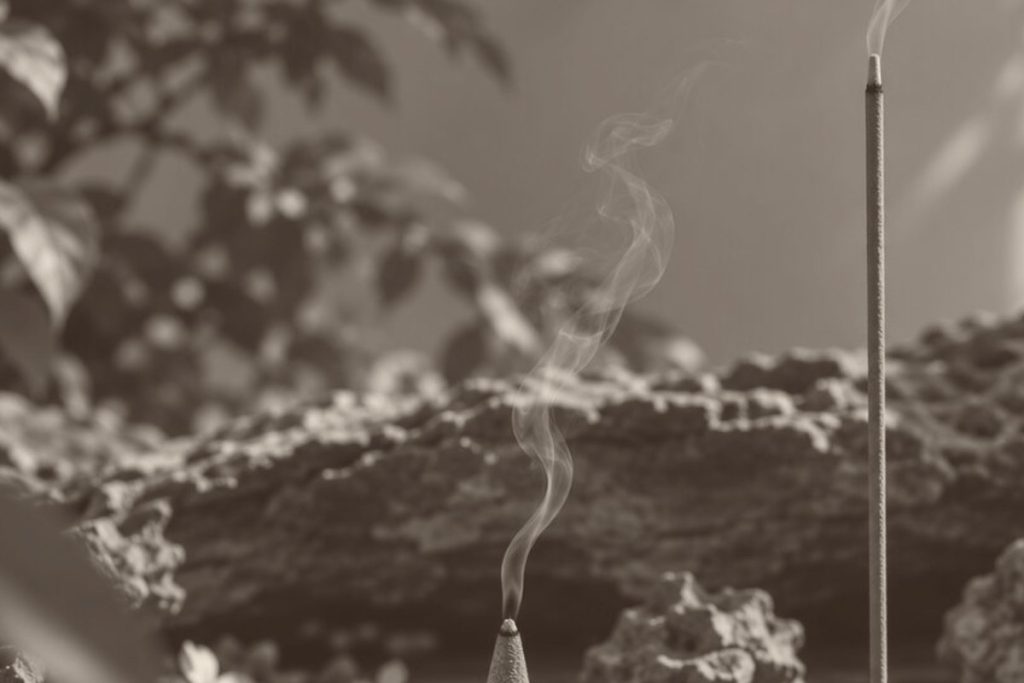
A dark backdrop and side light
Use a matte black cloth or card as the backdrop, about an arm’s length behind the holder. Velvet or rough paper absorbs light better than glossy paper. The farther the backdrop is from your light, the darker it will look and the more the smoke stands out.
Place the light to the side, or slightly behind the smoke, never from the camera’s direction. Side and back light make the particles glow like silk threads. You can use:
- a small desk lamp, shielded with a piece of card so it lights only the smoke;
- another phone’s torch, held low to one side;
- early sunlight through a gap in the curtains, while the room is still dim.
Keep light off the backdrop, or it will brighten and lose contrast. If you can, switch off other lamps in the room. For more on how light and shadow flatter smoke, read light and incense smoke through Tanizaki.
Keep the air still
Backflow smoke reacts to the slightest draught. A weak fan or even your breath can snap the ribbon. Before shooting, turn off fans and air conditioning, close the door for a few minutes so the air settles, and only then light the cone.
Still does not mean stuffy, though. When you finish, open a window so the room can air out. If you shoot for a long time, take breaks to ventilate, and avoid leaning close to the holder for long stretches.
One small trick: after lighting, wait a minute or two. The smoke is often flickery at first, and once the cone burns evenly the flow turns smoother and more continuous. How smoke travels in a room is covered in how incense smoke moves through a room.

Settings for phones and cameras
On a phone
- Rest the phone on a stand or against a stack of books, and use a two-second timer.
- Tap the smoke or the holder’s rim to focus, then hold to lock focus and exposure.
- Pull the brightness slider down one or two steps. A darker image deepens the black and makes the smoke brighter.
- In Pro mode, keep ISO low, typically 100 to 400.
- Turn the flash off. It flattens the smoke and adds an ugly glare.
On a camera
- Shoot manual with low ISO and an aperture around f/2.8 to f/5.6, so the background blurs while the smoke stays reasonably sharp.
- Use 1/200 s or faster to freeze each fold of smoke; a little slower gives a softer, silkier look.
- Focus manually on the holder’s edge, as autofocus often hunts in contrasty light.
- Shoot RAW if you can, so you can lift shadows without ruining the image.
Take plenty of frames. The smoke changes every second, and the best shot is often the one you did not plan.
A light edit, and a note on safety
In editing, a few moves are enough: add a little contrast, pull the blacks down for a clean backdrop, lift the highlights slightly so the smoke reads clearly, and reduce saturation if the colour drifts. Black and white also suits smoke well. Stop before the image looks harsh; the beauty of smoke lies in its fragility.
For safety, set the holder on a heat-proof surface, away from cloth, paper and plastic. Keep backdrops well clear of the burning tip. Never leave the room while a cone is burning, and put it out completely when you are done.
Photographing smoke is really a way of sitting still with something beautiful and brief. If a session produces no keeper, you still had ten slow minutes. The holder in your photo deserves care too: see cleaning ceramic backflow holders.
FAQ
What do I need to photograph backflow smoke with a phone?
A dark backdrop, a light from the side and very still air. Rest the phone on a stand, use a short timer, tap to lock focus and lower the brightness by a notch or two.
Why is backflow smoke hard to capture?
It is thin, clear and has no colour of its own; you see it only because light scatters on tiny particles. A bright or cluttered background makes the stream nearly vanish.
Should I use the flash?
No. Flash flattens the smoke and adds an unpleasant glow; light from the side or slightly behind works much better.
Smoke never stays, so we look more closely.