Incense in Buddhism is first of all a simple offering, usually understood as an expression of respect, purity and the wish to turn toward the good. A well-known idea is the “five-part fragrance of the Dharma body,” five symbolic “fragrances”: discipline, concentration, wisdom, liberation, and insight into liberation. This article is a respectful cultural overview, not a replacement for the teaching of monastics or particular schools.
Why is incense in Buddhism tied to temples?
Incense travelled with Buddhism across Asia. According to many sources, burning incense in ritual is very old in India and spread to the countries where Buddhism took root, blending with local custom. In Vietnam, incense became a familiar part of temple space: a soft smoke, bells, oil lamps, red sticks standing in a bronze burner.
As a symbol, incense is seen as a way to “open” a ceremony: a signal for worshippers to settle, focus and awaken a respectful heart before bowing or chanting. A pleasant scent also helps create the quiet atmosphere many people come to temples for.
The five-part fragrance of the Dharma body
In tradition, the “Dharma body” is the spiritual body of the practitioner, and “fragrance” here is not a material scent but the sweetness of virtue. The five parts are:
- Discipline: living honestly, keeping one’s word, not harming oneself or others.
- Concentration: a steady mind that is not swept away by every noise.
- Wisdom: seeing things as they are.
- Liberation: the lightness of letting go of unnecessary attachments.
- Insight into liberation: understanding and recognising that lightness.
When lighting a stick, many Buddhists contemplate these five as a reminder: the truly precious fragrance is not in the smoke but in inner qualities. This is the traditional understanding; you may meet slightly different explanations at different temples and in different books.
Offering incense gently
Practice varies by temple and tradition. Many places teach three sticks, linked to the Three Jewels (Buddha, Dharma, Sangha), while some use only one or a different kind of incense. A few common points:
- Tidy yourself, wash your hands and stand quietly for a moment before lighting.
- Hold the incense with both hands, facing the altar with respect.
- Place the sticks gently and upright, without waving or twirling them.
- Keep the mind still for a few breaths, then bow or chant according to what you believe.
If you are new to a temple, do not hesitate to watch and follow the guidance of the caretakers. Sincerity matters more than any procedure.
For three sticks and other readings, see why 1, 3 or 5 incense sticks.

Incense at home: simple and safe
Many Buddhist families keep a small altar at home. A simple, clean, modest altar is often considered more beautiful than one crowded with offerings. A few practical notes:
- Open a door or window while burning so smoke can leave, especially in small homes.
- Burn a moderate amount, since many sticks at once means more smoke.
- Choose natural incense with clear ingredients.
- Use a heat-proof burner, away from curtains, paper and dried flowers.
- Never leave it burning when no one is home or when asleep.
Studies of indoor incense smoke suggest it can raise fine particles in the air, so for older people, young children or anyone with sensitive lungs, burning less and ventilating well is also a way of caring for yourself and others.
The monthly custom is told in incense on the 1st and 15th of the lunar month.
Incense as a quiet practice
People sometimes ask whether lighting incense at home is “correct” in Buddhist terms. Many teachers answer that the heart is the core: lighting incense while full of irritation is hardly an offering, while one simple stick lit with gratitude is enough. So treat incense as a friend who reminds you to slow down, not as another pressure.
Whether or not you are Buddhist, the old way of seeing a stick of incense has something to teach: it burns slowly, releases its scent and ends as ash, a reminder that everything changes. Many people use the time one stick takes as a small timer for a few minutes of sitting still, watching the breath, doing nothing.
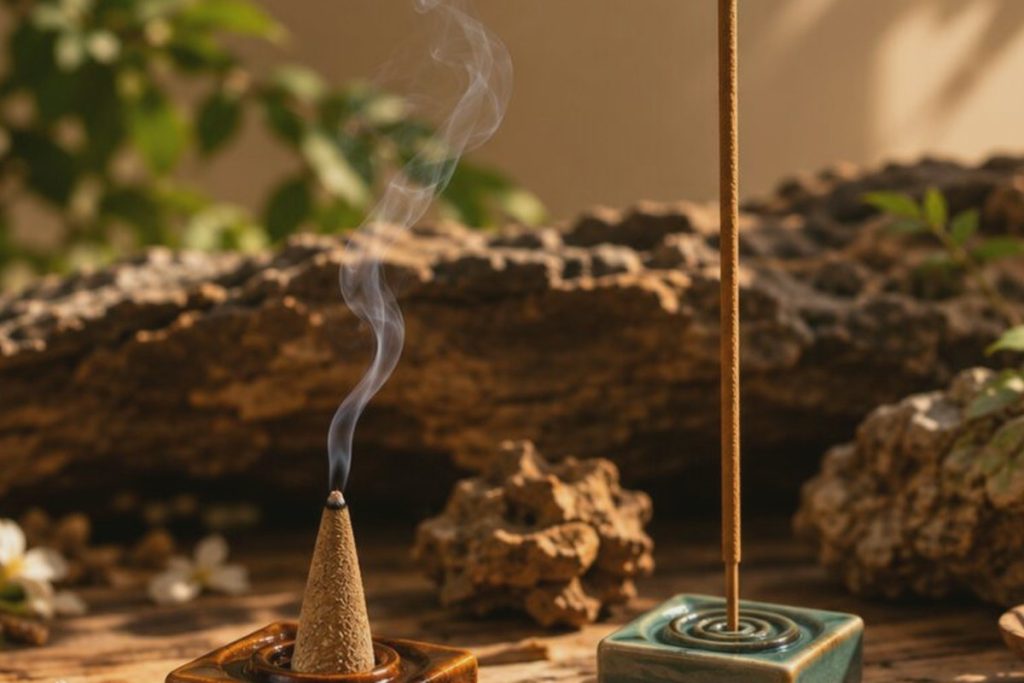
If you would like a corner like this at home, natural cones and ceramic holders are tidy choices. Browse them in the Yūgen shop, or use the scent finder to find a scent group that suits you. Incense is both culture and quiet; use it in the way that brings you peace.
To try a short practice, see five-senses mindfulness with one cone.
FAQ
What is the five-part fragrance of the Dharma body?
It refers to five symbolic “fragrances”: discipline, concentration, wisdom, liberation and the knowledge and vision of liberation. The “fragrance” is not a physical scent but the sweetness of virtue.
Why are three incense sticks common in temples?
Many places teach three sticks, linked to the Three Jewels: Buddha, Dharma, Sangha. Practice still varies by temple and tradition, and some places use one stick or a different kind of incense.
What should I keep in mind when burning incense at a Buddhist altar at home?
Open a door or window while lighting, light a moderate number, choose incense from natural ingredients, use a heat-proof burner away from curtains, paper and dried flowers, and never leave it burning when nobody is home.
The most precious fragrance is not in the smoke, but in the good we carry with us.