
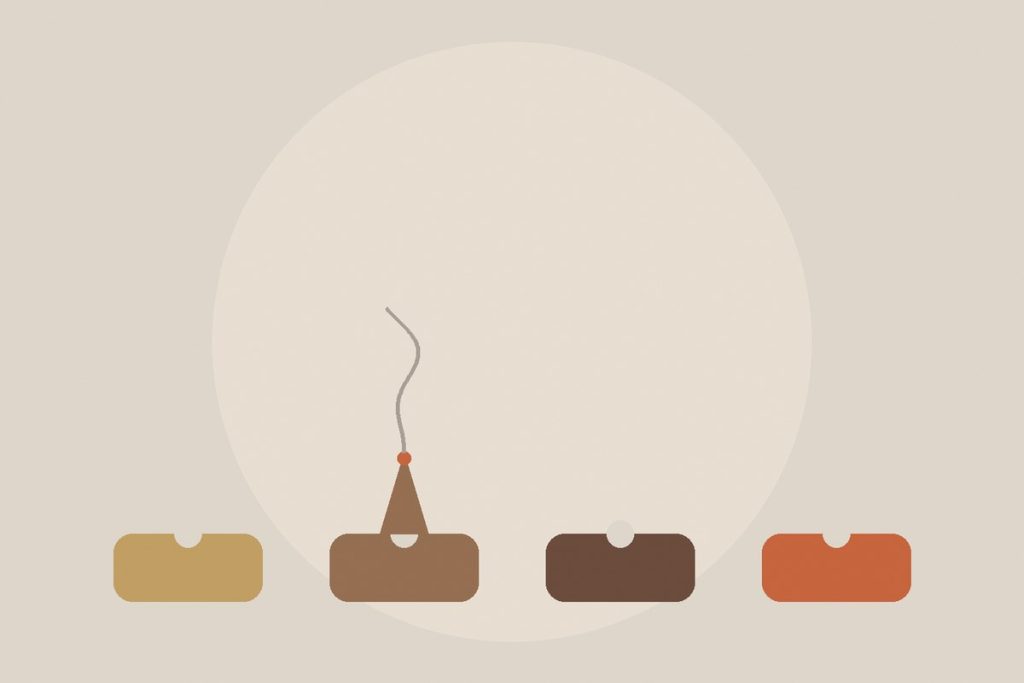
Wabi-sabi (侘寂) is the Japanese way of finding beauty in simplicity, imperfection and the marks of time. In handmade ceramics, it means a lopsided run of glaze, an uneven tone or a slightly curved line is not a flaw but a trace of the maker’s hand and the kiln’s fire. That is why every glazed holder has its own character.
Wabi and sabi: two words, one attitude
Wabi-sabi joins two ideas that began separate and gradually merged. “Wabi” first suggested the loneliness and poverty of someone living among nature; later it took a more positive sense: the beauty of simplicity, richness within lack, nothing fussy. “Sabi” relates to objects ageing with the years: patina, the dust of time, faded colour, worn edges. It is the beauty of something that has been used and loved.
The two words have no single definition, and the Japanese seldom try to explain them in detail. If we must summarise: wabi-sabi accepts that all things are incomplete and impermanent, and that nothing needs to be perfect to be beautiful.
From the tea ceremony to the lopsided bowl
The spirit of wabi-sabi is closely tied to the tea ceremony. Tea masters of the Muromachi and Azuchi–Momoyama periods, most famously Sen no Rikyū (1522–1591), preferred rustic tea bowls to glossy imported porcelain. Kilns such as Raku, associated with the potter Chōjirō, produced heavy bowls with deep glazes and asymmetrical forms. For those pursuing a simple tea room, a rough bowl holding warm tea was worth more than an ornate set.
A practice often mentioned alongside is kintsugi: mending broken pottery with lacquer mixed with gold powder, so the crack becomes a line of light rather than something hidden. Kintsugi expresses the idea clearly: a break is part of an object’s history, not something shameful. Still, note that kintsugi and wabi-sabi are related ideas, not identical.
Why handmade glazed holders are never identical
When pottery is fired, glaze reacts to heat, thickness and position in the kiln. A small difference changes the colour. A few things you may notice in handmade glazed ceramics:
- Uneven tone. Glaze pools thicker at feet and hollows and thinner at rims, making natural bands of dark and light.
- Glaze runs. Molten glaze follows gravity and leaves soft lines or small drops.
- Tiny specks. Small points from minerals or little bubbles in the glaze.
- Slightly different shapes. By hand, height, curve and thickness vary a little from piece to piece.
So the holder you receive may differ a little from the picture in tone and line. We regard that as a natural part of handmade work, not a defect. Of course, aesthetic imperfection is different from damage: if a holder has a deep crack, a sharp chip or will not sit steady, stop using it.

Living with wabi-sabi in your own corner
You do not need a tea room to bring this spirit home. A few simple ideas:
- Let one holder be seen. Give it a fixed place with space around it so the eye can rest.
- Choose less, use it well. One or two things you truly like beat a crowded shelf.
- Accept signs of use. A light smoke mark on the holder or a streak of ash is a trace of the times you lit incense.
- Look before you use. Spend a few seconds with the glaze before lighting, the way we look at a cup of tea before drinking.
In an age that prizes the new, smooth and uniform, wabi-sabi reminds us of the opposite: an object can gain value as we live with it. The holder darkens after many uses, the bowl picks up a worn spot at the rim, and both become yours alone. That is not an excuse for carelessness, but an invitation to look after what we already have.
To arrange holders on a shelf, see styling a shelf with ceramic holders, and for the deeper root of this kind of beauty, read what yūgen means.
Caring for a holder so it ages well
Glazed ceramics grow lovelier with regular use, but still need care. Wipe away ash once cool, wash gently with warm water and a soft brush, and let it dry completely. Avoid thermal shock, such as pouring cold water into a hot holder. When placing incense, always check that the holder is flat and stable, and remember the basics of fire safety: clear of flammables, never left unattended.
If you would like to see holders with their own character, visit the shop or read more in the Yūgen story.
To keep a holder clean and lasting, read cleaning ceramic backflow holders.
FAQ
What is wabi-sabi?
Wabi-sabi (侘寂) is the Japanese way of finding beauty in simplicity, imperfection and the marks of time. In handmade ceramics, a lopsided run of glaze or an uneven tone is not a flaw but a trace of the maker’s hand and the kiln’s fire.
Why are handmade glazed holders never identical?
In the kiln, glaze reacts to heat, thickness and position, so tone, glaze runs, tiny specks and shape differ slightly from piece to piece. The holder you receive may differ a little from the product photo.
How do I care for a glazed ceramic holder?
Wipe off cooled ash, rinse gently with warm water and a soft brush, let it dry fully, and avoid thermal shock.
A lopsided glaze does not make a holder lesser; it is the signature of a hand.