

What is yūgen? Yūgen (幽玄) is a Japanese aesthetic idea for a subtle, profound beauty that is not fully stated, the feeling that something greater lies just beyond what the eye sees. From Heian poetry to Zeami’s Noh theatre, it is one of the central ideals of Japanese art. It is also why we named our brand this way.
What is yūgen: the characters and original meaning
Yūgen is written with two Chinese characters. “Yū” (幽) suggests dimness, seclusion and hiddenness, like a deep valley or a path lost in mist. “Gen” (玄) means dark, deep and mysterious. Together the word first meant “deep, dim, hard to fathom” and was used in Chinese philosophical and religious texts. In Japan it gradually became a concept of beauty.
Notably, yūgen resists neat translation. “Mysterious profundity”, “subtle depth” and “dark elegance” each catch part of it, and none fits exactly. Perhaps that is part of the concept: it does not want to be fully defined.
From old poetry to Zeami and Noh
In waka poetry of the Heian and Kamakura eras, poets such as Fujiwara no Shunzei used yūgen to speak of lingering resonance, the layers of meaning beneath the words. A yūgen poem does not describe the whole scene; it lets the reader fill in what is missing. One often-evoked image is an autumn evening: no bright colours, no particular sound, yet the heart is moved.
In the Muromachi period, Zeami Motokiyo (c. 1363–1443), who with his father laid the foundations of Noh, placed yūgen at the heart of the stage arts. In his treatises it is usually understood as a graceful, gentle beauty expressed through slow gestures, restrained voice and silence. A Noh actor need not do much; a small movement of the hand or a single step can reach the audience. Zeami’s exact understanding may shift across his career, and scholars still debate it, so we give only the main idea.
Where do we meet yūgen in life?
It helps to think of yūgen not as an object but as a way of perceiving. A few moments people tend to name it for:
- Mist covering half a mountain, revealing only a distant outline.
- Moonlight through thin cloud.
- A temple bell sounding far off, source unknown.
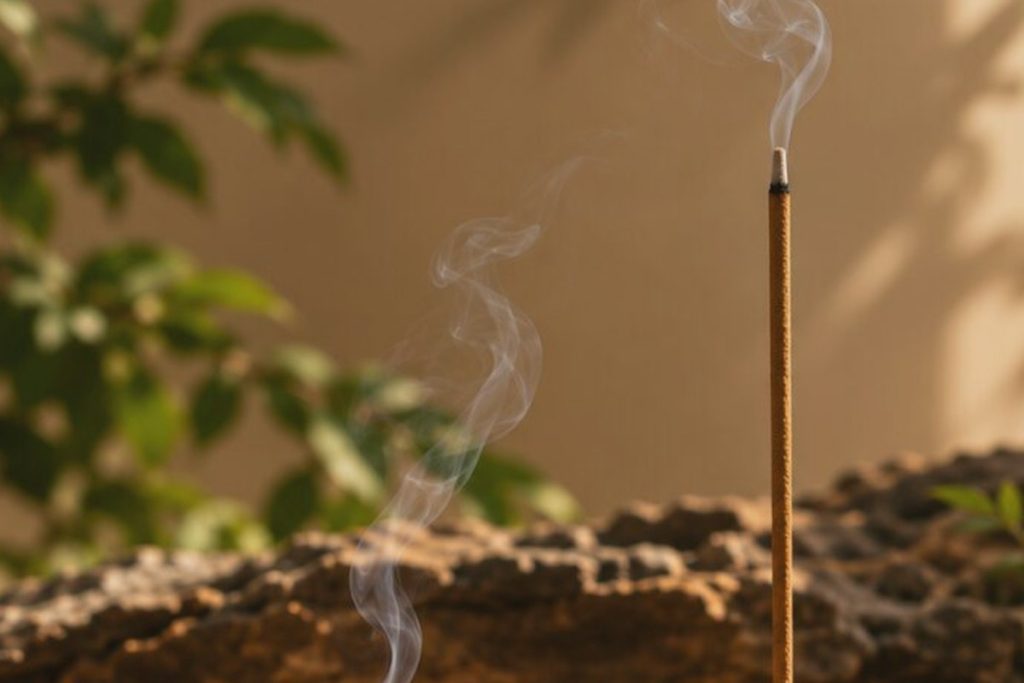
- A slender thread of incense smoke that climbs and dissolves into the air.
- An empty space in an ink painting, filled in by imagination.
What they share is suggestion. Instead of showing everything, they leave room for the viewer. Beauty lives not in the thing, but in the space between the thing and the one who perceives it.
A neighbouring way of seeing is wabi-sabi and handmade ceramic holders, and for smoke in the dark, see light and incense smoke through Tanizaki.
Why incense suits yūgen so well
Incense may be among the most natural expressions of yūgen. Smoke is visible for a moment, then gone. A scent has no shape and cannot be photographed, yet it calls up memory and mood. You cannot own it; you can only stay beside it while it lasts.
Incense also asks for quiet attention. To hear a delicate scent we must slow down, lower the noise around us and breathe deeper. That attitude is yūgen in miniature: not much is needed, only presence.
You can practise this with three small acts: remove one thing from your desk so the eye can rest, spend a minute watching the smoke before doing anything else, and describe a scent in three words, then stop. What goes unsaid is part of the experience too.
The old words in praise of incense carry the same breath; see the ten virtues of incense.
Yūgen in our brand
We chose Yūgen as a name for a simple reason: a scent should be more like a whisper than a declaration. When we make cones from wood, herbs and other natural ingredients, we want the fragrance gentle enough not to overwhelm you, and clear enough that you notice your home slowing down. That is also what lies behind our tagline, “Hiểu mình, thương mình” (understand yourself, be kind to yourself): a small quiet space to listen to yourself.
We do not claim to have reached yūgen; it is an ideal to lean toward, not something you can package. If you are curious, read our story, try the scent finder, or browse the scent groups.
And if you would like to feel yūgen today, you need very little: a cone, an open window and five minutes watching smoke dissolve. Light it somewhere airy and put it out fully afterwards.
FAQ
What is yūgen?
Yūgen (幽玄) is a Japanese aesthetic idea for a subtle, profound beauty that is not fully stated, as if something greater lay just beyond what the eye sees. The character “yū” suggests dimness and concealment, while “gen” means deep black, profundity.
How is yūgen different from wabi-sabi?
Yūgen speaks of a deep beauty that is hinted at rather than fully said; wabi-sabi speaks of the beauty of simplicity, imperfection and the marks of time. They differ, but can meet in the same corner of a home.
Why is the brand called Yūgen?
We chose the name because a scent should feel more like a whisper than a declaration. Yūgen is an ideal to move toward, not something that can be packaged.
The deepest beauty is often what is only hinted at, never fully said.