A 20-Minute Relaxing Incense Ritual Before Bed

A bedtime incense ritual doesn’t need to be elaborate: dim the lights, burn one softly scented cone 30–45 minutes before bed, sit and breathe slowly while it burns, then let it go out completely and air the room before you lie down. What matters is not what the scent “does”, but that repeating a small sequence every evening tells you, gently, that it’s time to slow down.

Why a small ritual helps you unwind

Body and mind love rhythm. When you do the same things in the same order each evening — a cup of tea, washing your face, lighting incense — they become a signal that the day is over. In Japan, the appreciation of incense is described as “listening to incense”: not just smelling it, but giving it your full attention for a few minutes. That is the spirit of this ritual.

Note: incense is not a treatment for insomnia. If you have trouble sleeping for a long time, please talk to a doctor. For what science can and cannot say, see scent and sleep.
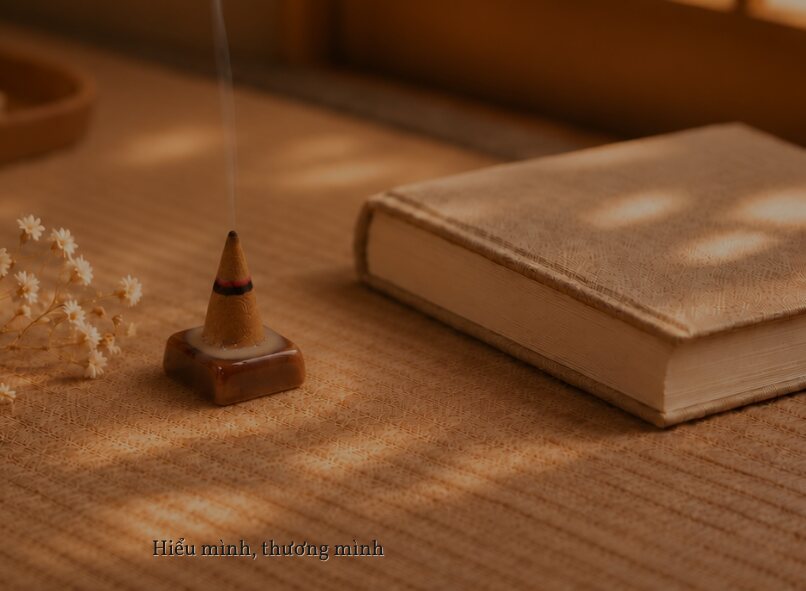
Nụ hương cháy bên cuốn sách
One small cone, one page, and the room slows down.

A five-step, 20-minute ritual

Step 1: Set up a small corner (2 minutes)

Choose a table or shelf near where you sit, not your bedside. Place your holder, a lighter and perhaps a cup of caffeine-free herbal tea. Put your phone away or switch on Do Not Disturb.

Step 2: Lower the lights (1 minute)

Turn off the ceiling light and keep a small warm lamp. Soft light helps eyes and mind shift into rest.

Step 3: Light and watch (3 minutes)

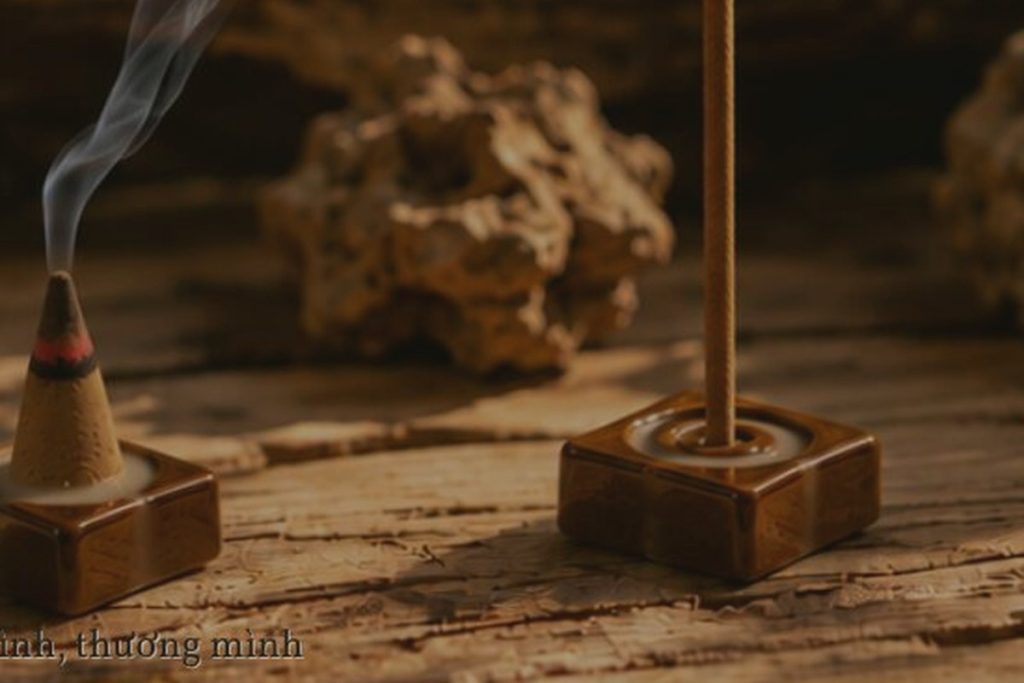
Light the cone, blow out the flame and set it on the holder. Spend a few minutes simply watching the first thread of smoke. With a backflow cone on a ceramic holder, the smoke drifts down like mist, which is wonderfully calming to watch.

Step 4: Breathe slowly (5–10 minutes)

Sit comfortably and try 4–6 breathing: in through the nose for four counts, out slowly for six. With each breath, notice how the scent changes — wood, sweetness, smoke. When your mind wanders to tomorrow, gently bring it back to the scent. There is another exercise in slow breathing with incense smoke.

Step 5: Close the day (3 minutes)

Write down three things you’re grateful for, or one thing you did well today. This is your moment of self-kindness. As the cone finishes, open a window or door slightly to let the air move.

Which scents suit the evening?

Scent is personal, but in the evening many people prefer warm, deep, not-too-sweet notes:

  • Agarwood: deep and still, ideal for sitting quietly.
  • Warm wood: like sitting by a fireplace, lovely on rainy nights. Try Kei cones.
  • Sage: clear and clean, good for “resetting” the room after a busy day.

Not sure yet? Use the 5-scent sampler: one scent each evening for a week, noting how each feels.

Khói hương lan tỏa như sóng âm
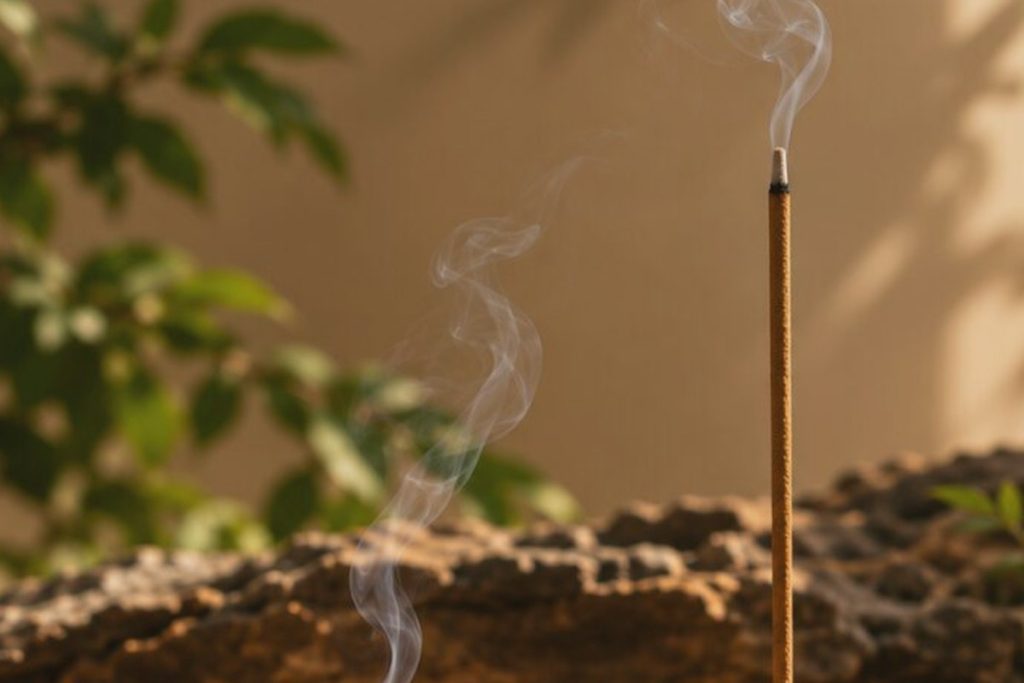
Smoke spreads like ripples: let the scent come to you.

What to avoid

  • Never burn incense while asleep: always let it burn out and cool before bed.
  • Don’t place it by the bed or near bedding and curtains.
  • Don’t burn it in a sealed room: air out an air-conditioned bedroom afterwards, or burn it in the next room.
  • Don’t overdo it: one cone is enough. A scent that is too strong works against relaxation.

FAQ

How long before bed should I burn incense?

About 30–45 minutes, so the cone burns out and the room has time to air.

Can I use sticks instead of cones?

Yes. Sticks burn longer with a lighter scent. Cinnamon Wood sticks suit a slightly longer ritual.

What if a child sleeps in the same room?

Burn incense in another room and keep children away from direct smoke.

What if I don’t have 20 minutes?

Five minutes is enough: light, dim the lights, take ten slow breaths. Consistency matters more than length.

Find more scents and ceramic holders in the Yūgen shop.

Why the Japanese call it “listening” to incense

In Japanese, appreciating incense is not called “smelling” but mon-kō (聞香) – “listening to incense”. The character 聞 means to hear. It is not wordplay: it describes an attitude, one where scent is received slowly and attentively, the way you listen to someone speaking.

Khói hương lan tỏa như sóng âm
Scent spreads like sound waves; the listener only needs to be still.

Kōdō – the way of incense

Alongside the tea ceremony and flower arranging, kōdō (香道) is one of Japan’s three classical refined arts. Aromatic wood arrived with Buddhism around the sixth century; by the Heian period, aristocrats were blending their own incense and holding scent-guessing games. In the Muromachi period the rituals were formalised into a “way”, with its own tools, rules and aesthetics. See a short history of Kōdō.

In a kōdō session, nothing is set alight directly. A sliver of fragrant wood rests on a mica plate above ash with a buried ember. Gently warmed, the wood releases its scent with almost no smoke. The censer is passed around; each guest lifts it, cups it with a hand, breathes in slowly three times – and stays silent.

Why call it “listening to incense”?

Smelling is active: we search for a scent and judge it. Listening is different. We step back and let the sound come, without interrupting. “Listening to incense” invites the same: no quick judgement, just letting the scent tell its story – the opening, the heart, and the lingering trace.

It is also a reminder that scent, like music, has rhythm and time. It shifts minute by minute with the warmth and the air in the room. To take it all in, you have to be fully present.

Không gian gỗ và đá tự nhiên
A quiet room and natural materials – the setting for “listening”.

The ten virtues of incense

Japan has long passed down the “Ten Virtues of Incense” (香の十徳), traditionally dated to the Muromachi era. Among them: incense purifies the mind, eases fatigue, keeps you company in solitude, offers a pause amid busyness, and never tires with long use. Incense here is not decoration but a companion to the mind. A closer reading is in the ten virtues of incense.

Bringing mon-kō home

You need no kōdō tools or embers to practise. Just one cone and fifteen minutes:

  1. Lower the noise. Put the phone away, turn off the music.
  2. Light a cone and sit close. Do nothing else. Just sit and breathe slowly.
  3. Meet the first note. Wood? Herbs? Sweet or dry? Notice it; no need to name it correctly.
  4. Wait for the next layer. After five or ten minutes the scent changes. Is it softer, warmer?
  5. Listen to the echo. When the cone burns out, stay a little longer. What remains is often the most beautiful part.

That is also the spirit behind the name Yūgen (幽玄): a deep, quiet beauty that reveals itself only to those slow enough to notice. Learn more in What Is Yūgen? If you would like to start with a scent that suits you, try Yūgen’s scent finder.

FAQ

What does mon-kō mean?

Mon-kō (聞香) means “listening to incense”. The character 聞 means to hear, so appreciating incense is understood as receiving scent slowly and attentively.

What is kōdō?

Kōdō (香道) is one of Japan’s three classical refined arts, alongside the tea ceremony and flower arranging, with its own tools, rules and aesthetics.

Do I need kōdō tools to practise listening to incense at home?

No. You only need one cone and about fifteen quiet minutes: sit close, breathe slowly and notice how the layers of scent change.

Incense does not need to be understood. It only needs to be listened to.

Pomelo peel: the scent of Tết

Pomelo is one of the clearest scents of Tết for Vietnamese people: the leaf-water of New Year’s Eve, a golden fruit on the altar, peel drying in a corner of the kitchen. In handmade incense, pomelo peel brings a fresh, slightly bitter citrus note that lifts heavy wood and cinnamon. This article tells of the custom, where the scent comes from and how peel enters incense.

The pomelo tree and its scents

The pomelo (Citrus maxima, sometimes written Citrus grandis) is a citrus fruit tree found in nearly every Vietnamese garden. Each part has its own scent: the blossom is sweet and delicate, usually opening in early spring; the leaves smell green and cool; the rind is fresh, slightly bitter and rich in oil.

Citrus peel oils contain a lot of limonene, a compound that gives bright, clean citrus notes. That is why simply peeling a pomelo fills the room with scent. As the peel dries, the aroma softens, becoming warmer, less fresh but deeper. For the holiday, see incense gift sets for Tết.

So Vietnamese households have long used the blossom, leaves and peel in many ways, from scenting tea to washing hair to cooking sweet soups, and especially in the last days of the year.

Dried herbs, marigold and wood: ingredients for the scent of Tết

Pomelo-leaf baths on Tết Eve

One custom many families remember is bathing in leaf-water on the last afternoon or evening of the year. Water is simmered with pomelo leaves and other fragrant leaves such as lemongrass, lime leaves, kinh giới, hương nhu or perilla, and used for bathing or washing hair. According to folk belief, it is a way to “wash away” the misfortunes of the old year and welcome the new one lighter and cleaner.

It is a custom tied to belief and to the feeling of a fresh start, and we simply tell it as part of the culture. Each region and household picks leaves differently, so there is no single recipe.

What is easy to notice is that the green, cool scent of pomelo-leaf water changes the air of the house. For many people it is a plain signal that the old year is closing: the house has been cleaned, everyone has bathed, and everything slows by a beat.

The fruit on the altar and in the house

Pomelo also appears in the Tết fruit tray in many households, especially in the north. People often choose round, golden, large fruit with a green stem as a symbol of fullness and comfort. The exact meaning varies by region, and this is a folk understanding rather than a rule.

During Tết, the pomelo’s gentle scent drifting from the tray mixes with incense, peach blossom and the smell of cakes, forming the particular “Tết smell” that many people living far from home miss most. It is not just the smell of a fruit; it is the memory of a whole house on a day of reunion. Year-end also brings trimming incense stubs before Tết.

Fragrant leaf-water on the last day of the year

Pomelo peel in incense recipes

Peel that has been dried and ground to a fine powder can be used in herbal incense as a bright top note. It lifts woody scents, softens the sweetness of cinnamon and star anise, and brings a hint of Tết atmosphere without adding artificial fragrance.

  • Pomelo peel + cinnamon: warm, sweet, like a kitchen at year’s end.
  • Pomelo peel + star anise: fresh sweetness, a clear sense of cold season.
  • Pomelo peel + wood or agarwood: a bright note beside a deep base, for balance.

Because citrus oils evaporate easily, the scent of pomelo peel in a cone is often brief at the start, then gives way to woody and herbal notes. That is why it is used to brighten a blend rather than lead it.

To get to know it, keep a few pieces of dry peel in a small jar on a shelf and enjoy the raw scent without burning anything. Just make sure the peel is fully dry so it does not go mouldy.

In Vietnamese homes the peel also has a humble second life: carefully peeled, cut into strips and dried for sweet soups, or placed in a wardrobe for fragrance. Not wasting the rind but finding it a scent to stay in is a lovely slow-living habit, and one we try to keep when making incense: use well, and respect the material.

Using pomelo scent gently at home

Pomelo suits kitchens, living rooms and mornings that need a fresh note. Burn in moderation and open a window; any incense smoke can irritate sensitive people. If you have cats, note that some citrus essential oils may not suit them, so favour ventilation and keep incense out of reach of pets and small children. Pomelo suits many months, see matching incense scents to the seasons.

To meet warm citrus inside a balanced blend, look at the herbal cones or try the Scent Finder to find a scent group that fits you.

We speak only of scent and custom, and make no healing claims.

FAQ

What does pomelo peel smell like in incense?

A fresh, light citrus note that many Vietnamese people associate with Tết.

What is a pomelo-leaf bath on Tết Eve?

A folk custom on New Year’s Eve, described here as culture rather than a health claim.

How can I use pomelo scent gently at home?

Use it in moderation, keep the room ventilated and never leave a flame unattended.

At the year’s end, one passing breath of pomelo is enough to say home is near.

Matching Incense Scents to the Seasons

Matching incense scents by season is simpler than it sounds. An easy way to choose a scent is to look out of the window: hot days call for light herbal notes, chilly evenings suit warm cinnamon and resin, spring and gentle afternoons welcome sweetness, and autumn feels at home with wood. These are not rules, only suggestions drawn from how the body feels in different weather.

This guide uses Yūgen’s four scent groups (Woody, Herbal, Agarwood and Soft & sweet) as a frame for the seasons.

Why incense scents by season make sense

Our bodies respond to weather more than we think. On a muggy day we want air that is open and dry. On a cold winter evening we look for warmth and depth. Scent is closely tied to memory and mood, so it naturally follows the same rhythm. A deep resin note can make a sticky afternoon feel heavier, while warm cinnamon suits a cold rainy night. To go finer by the hour, see incense for different times of day.

Asian traditions share this attention. The Japanese choose incense by season in kōdō gatherings, and Vietnamese households burn plants tied to certain times of year, such as pomelo leaves at Tết. Choosing scent by season simply continues an old observation: we live alongside the weather.

Of course, your own taste always has the last word. If you love resin in summer, burn it, just open the window wider.

Wood, stone and soft light, materials that follow the four seasons

The four groups, briefly

  • Wood: dry, warm and grounded, recalling pine forest, tree trunks and old bookshelves.
  • Herbal: green, clean and light, like leaves, grass roots and freshly picked stems.
  • Agarwood: deep, layered and slow, the scent of precious wood resin.
  • Soft & sweet: mellow and warm, with hints of flowers, citrus peel or sweet spices such as cinnamon and star anise.

These are general impressions. Each product has its own character, so it is best to smell before you decide.

The warm months: spring and summer

Spring: light, like a body just waking up

Spring in northern Vietnam is often cool, with light drizzle and some muggy days. Scents that suit it are the gentler Soft & sweet group or green, dry Herbal notes that keep a room from smelling of damp. Burn moderately, open a window a crack, and if the air is very humid, store your cones carefully so they keep burning evenly. A warm note for cooler months is cinnamon: the scent of warmth.

Summer: favour light and airy

On sticky hot days, heavy smoke can make a room feel closer. Choose the Herbal group: the scent of leaves, roots and grass stems is naturally fresh and clean. Burn with a window open, or on a balcony or porch where a breeze moves. Choose a small cone, burn one, and stop there. When a room is closed and air-conditioned, remember that ventilation comes first, then scent.

A cone and a cup of tea for an afternoon between seasons

The cooler months: autumn and winter

Autumn: wood and stillness

Autumn brings golden light, dry leaves and crisper air. The Woody group suits it especially well: dry, moderately warm, like sitting by a window with a book. It is also when many people start to enjoy gentle resin again as the heat eases.

Winter: cinnamon, resin and warmth

When it is cold, cinnamon and resin really shine. Cinnamon feels warm and sweetly spiced, like a cup of ginger tea or a thin blanket. Agarwood brings depth and calm. On winter evenings, a cinnamon or resin cone beside a yellow lamp is a pleasant slow moment.

An important note: in cold weather we often close the doors, so smoke gathers more easily. Open a window a crack, burn briefly, and never burn in a room that is sealed. Another sweet, warm note is star anise in handmade incense.

In the south: two seasons, two rhythms

In the south and much of the tropics, weather divides mainly into dry and rainy seasons. The same thinking applies: scorching days suit airy Herbal notes, while long rainy afternoons suit Woody, Agarwood or a warm sweet note. Heavy rain is also when cones turn damp easily, so store them well.

A quick table

Moment Suggested group Feeling
Hot, sticky day Herbal Light, clean, airy
Spring, mild afternoon Soft & sweet, Herbal Mellow, fresh
Autumn, dry air Wood Dry, still
Winter, cold evening Agarwood, Soft & sweet (cinnamon) Warm, deep
Long rain Woody, Agarwood Warm, settled

If you would like a quick suggestion by mood, try the scent finder, or browse the groups in the shop.

FAQ

Which scents suit summer?

Hot days call for light herbal notes.

Which scents suit winter?

Chilly evenings suit warm cinnamon and resin.

How do I find what suits me?

Try a different group each evening for a week and note how each feels.

A scent for the season lets a home breathe in time with the world outside.

A Short History of Kōdō: From Driftwood to Ritual

Kōdō (香道), “the way of incense”, is Japan’s art of appreciating fragrance. The history of kōdō begins, by the earliest account usually cited, in 595 when a log drifted ashore on Awaji Island, while the shaping of a full “way” came centuries later in the Muromachi period. This is a brief, unacademic walk through that journey.

The driftwood on Awaji

The best-known source is the Nihon Shoki, Japan’s chronicle completed in the early 8th century. It says that in 595 islanders on Awaji found a large log washed ashore. They added it to a pile of firewood and burned it, then were surprised by the unusual fragrance that spread. The wood was presented to the court, and it is generally understood to have been agarwood (jinkō), the resinous wood still at the heart of the art.

It is a vivid tale, and worth reading carefully: historians treat it as the earliest record of agarwood in Japanese history, not as proof that incense was unknown there before. Around the same period, Buddhism arrived from the continent and brought the offering of incense in ritual. Incense came to Japan first as an object of the temple.

Agarwood, the material tied to the first story of Japanese incense culture.

The Heian period: incense as a court pastime

By the Heian period (794–1185), incense had left the temple for aristocratic life. Courtiers blended powdered aromatics with honey and other ingredients, pressed into pellets known as nerikō or takimono. Each person had a signature blend, and the scent clinging to clothes became a personal mark. Murasaki Shikibu’s Tale of Genji is full of such moments, to the point that two characters, Kaoru and Niou, have names tied to fragrance.

Guessing and comparing scents also appeared then as an elegant diversion, a forerunner of later incense games.

Kamakura and Muromachi: incense becomes a “way”

When the warrior class took power in the Kamakura period (1185–1333), taste shifted from elaborate blends toward savouring a single pure fragrant wood, in tune with the simplicity and quiet of Zen. Agarwood, burned in tiny slivers, suited that mood.

In the Muromachi period (1336–1573), under the eighth shogun Ashikaga Yoshimasa, cultural life flourished. Around him, tea, flower arranging, Noh and incense were all refined. Two figures often named in the systematising of incense are Sanjōnishi Sanetaka and Shino Sōshin, later regarded as founders of the two major schools. From this period, appreciating incense was no longer mere amusement but had rules, tools and manners of its own: a “way”.

Classification and etiquette: six countries and five tastes

One legacy of this formative era is how people described agarwood. They sorted it into six “countries” (rikkoku), Kyara, Rakoku, Manaka, Manaban, Sasora and Sumotara, and by five “tastes” (gomi): sweet, sour, hot, salty and bitter. According to many sources, these names echo places in Southeast Asia from which agarwood reached Japan by trading ship, and Vietnam is often mentioned for fine grades. Of course this is a vocabulary for scent, not for the tongue. It shows how finely people once listened to fragrance, comparing and naming it.

Appreciation in this style is not called smelling but “listening” (monkō): you hold a small burner in your palm, breathe slowly and let the mind settle. The phrase itself is a lesson in attention.

The two great traditions of this age are told in Oie-ryū and Shino-ryū, and the guessing games in kumikō.

From old texts to a reading corner today, incense remains a companion to stillness.

A history of kōdō: the Edo period and today

In the Edo period (1603–1868), with peace and a prosperous merchant class, the art spread from nobles and samurai to ordinary people. Games such as kumikō developed, many rules and tools were standardised, and teachers passed their methods down through household lineages that still exist today. Incense sticks (senkō) also became common in daily life, at home and in temples, so that fragrance moved easily between ceremony and ordinary days.

Today kōdō is still studied through traditional schools, alongside very everyday approaches: someone sits by a window, lights a cone, and spends fifteen minutes doing nothing at all. We do not think you need every ritual to call it a “way”. What is worth keeping is attention: look, breathe, and let things settle.

If you would like to try that in a friendlier form, read the Yūgen story, or choose a scent in the shop and give it one slow afternoon. Open a window and burn in moderation.

To read on about the old spirit of incense, see the ten virtues of incense.

FAQ

What is kōdō?

Kōdō (香道) is Japan’s art of appreciating fragrance. Practitioners do not simply “smell” but “listen to incense” (monkō): holding a small burner in the palm, breathing slowly and letting the mind settle.

When did kōdō begin?

The earliest account usually cited is in the Nihon Shoki: in 595 a log drifted ashore on Awaji Island. The shaping of a full “way” came centuries later, in the Muromachi period.

How is kōdō different from ordinary incense burning?

Kōdō savours small pieces of fragrant wood, chiefly agarwood, with slow and quiet attention, rather than scenting a whole room.

From a log on the shore to a cone on your desk, the thread is the same: listening.

Oie-ryū and Shino-ryū: The Two Schools of Japanese Incense

Japanese kōdō, the way of incense, has two great traditional schools: Oie-ryū and Shino-ryū. By tradition, Oie-ryū comes from Sanjōnishi Sanetaka, a court noble, and Shino-ryū from Shino Sōshin, who served the shogun Ashikaga Yoshimasa. Both grew up in the Muromachi period and are still studied today.

Background: an age of refined arts

To understand the schools, look back at the Muromachi period (1336–1573), especially the later fifteenth century, when Ashikaga Yoshimasa patronised many arts: tea, Noh, flower arranging, painting and incense. Around the shogun were people who knew incense well, both aristocrats of the capital and close associates from the warrior class. The first rules for appreciating incense came out of that circle.

The two schools are therefore not opposites but two branches from one root, each carrying the mark of its founder and the world around him. An honest caution: many details about the earliest figures, especially Shino Sōshin, are thinly documented, so accounts differ slightly. We mention only what is fairly consistent.

For the bigger picture, read a short history of kōdō.

A minimal setting where scent is the centre of attention.

Oie-ryū: the school of the aristocracy

Oie-ryū (御家流) is usually traced to Sanjōnishi Sanetaka (1455–1537), a noble, scholar and poet in the capital. He knew classical literature and court ritual well, and is credited as a major contributor to organising and recording ways of appreciating incense. His diary, the Sanetaka-kō ki, is still used by scholars as a precious source on cultural life at the time, incense included.

Because it grew from an aristocratic setting, the school is often described as having the graceful elegance of the court, tied to classics such as the Tale of Genji. That is a generalisation, not a rigid rule.

Shino-ryū: the school linked to the warrior class

Shino-ryū (志野流) is traced to Shino Sōshin, a contemporary who served in Ashikaga Yoshimasa’s circle. Later the school became associated with samurai and was handed down through generations within the Shino family.

It is often said that Shino-ryū has the calm, disciplined manner of the warrior households, but again this is a generalisation that today’s students may not fully agree with. What is more certain is that both schools were transmitted through teacher and pupil, in family lineages lasting centuries.

Oie-ryū and Shino-ryū: what they share, and where they differ

Despite differences in style, names of tools, arrangement and sometimes scoring conventions in incense games, the two schools have a great deal in common:

  • Agarwood at the centre. Both use tiny chips of agarwood, warmed gently over coals buried in ash rather than burned outright.
  • Tools. A censer, sculpted ash, a thin mica plate between heat and wood, and small implements for shaping ash are familiar to both.
  • The way of listening. The guest holds the censer in the palm, cups it, breathes in gently a few times, then passes it on.
  • Incense games. Kumikō, the guessing game, belongs to both traditions.

To an outsider, these small differences matter less than what the schools say together: a very slow kind of attention, polished over many generations. A session is usually very quiet: the host prepares the ash, sets the coal, places the mica and a tiny chip of agarwood, then hands the censer to the first guest. Nobody says much. Each person receives it, breathes, and passes it on, as if the whole room were keeping one slow breath.

Both schools play guessing games, described in kumikō, the incense guessing game.

Listening to incense, like drinking tea, is a way of slowing down to pay attention.

What do they mean for us today?

You do not need to join a school to enjoy the spirit of kōdō. But these two lineages offer a few things worth thinking about:

  • An art can be carried on by patience, through particular teachers, not only through books.
  • Form (how you hold, turn and sit) is not meant to be difficult but to keep the mind on one thing.
  • One spirit can have several voices: courtly grace and warrior calm are both ways of speaking about settling down.

At home you can borrow a little of this very simply: light a cone, rest your hands on your lap, breathe slowly three times and notice one thing you smell. Open a window and put the incense out fully when you finish; the point is not to perform, only to notice. For a gentle start, try the scent finder or read our story.

And for old words in praise of incense, see the ten virtues of incense.

FAQ

How do Oie-ryū and Shino-ryū differ?

Oie-ryū is usually described as the school of the aristocracy, with a court-like elegance, while Shino-ryū is tied to the warrior class, with a calm, precise manner. These are generalisations, and present-day students may not fully agree.

Who founded the two schools?

By tradition, Oie-ryū comes from Sanjōnishi Sanetaka, a court noble, and Shino-ryū from Shino Sōshin, who served in the circle of the shogun Ashikaga Yoshimasa.

Do I need to study a school to enjoy incense?

No. You can borrow the spirit simply: light a cone, rest your hands on your lap, breathe slowly three times and notice one thing you smell, with a window open.

Two schools, one spirit: slow down and listen for something very quiet.

Kumikō: The Incense Guessing Game and Its 52 Patterns

Kumikō (組香) is a family of Japanese incense games in which players listen to several scents in turn and guess which ones match. The best known is Genjikō, which uses five packets and has exactly 52 possible answers, each named after a chapter of the Tale of Genji. It sounds elaborate, but the core idea is simple: pay very close attention.

What is kumikō?

“Kumi” means to group or combine, and “kō” means incense. A kumikō set combines several scents into a theme, often inspired by poetry, literature or the season. Players do not just identify smells; they also enjoy the literary setting that comes with them.

Unlike appreciating one scent alone, kumikō is a group activity. People sit in a circle, take the censer in turn, breathe, record their impressions, and compare at the end. Its charm is that it is both a game and a training for smell and memory, without heavy competition. Traditionally the rounds and results are written with a brush on paper, so everyone can look back after the session.

Different scents call up different memories, which is the raw material of the game.

Genjikō: five packets, 52 diagrams

Genjikō (源氏香) is the best-loved kumikō, named for the Tale of Genji, the classic novel by Murasaki Shikibu written around the early eleventh century. In simplified form, it goes like this:

  1. The host prepares five kinds of incense, each divided into five packets, twenty-five in all.
  2. The packets are shuffled and five are drawn at random to be burned one at a time.
  3. Players listen to each round and ask: does this match the one before?
  4. At the end, each person draws their answer: five vertical lines stand for the five rounds, and lines joined by a horizontal bar across the top are rounds judged to be the same scent.

Because rounds can match or differ in many combinations, the number of possible patterns is 52. This is no accident: it equals the number of chapters in the Tale of Genji once you leave out the first and last (54 minus two). Each diagram is named after a chapter, so an answer is also a literary name. A mathematician would say 52 is simply the number of ways to split five things into groups, but people of the past saw it through poetry rather than numbers.

Kumikō grew out of the incense tradition; see a short history of kōdō and Oie-ryū and Shino-ryū.

Why is guessing scents hard, and fun?

Our sense of smell is closely tied to emotion but hard to name precisely. Few people can say “this is cinnamon, this is agarwood” without practice. Kumikō does not demand names, only comparison: same or different. That is a gentler task, and so it suits beginners.

A few things become clear as you play:

  • The nose tires quickly. After a few rounds your sense adapts and scents seem weaker. Players traditionally rest between rounds and sometimes take a clean breath before listening again.
  • Memory helps, and misleads. A familiar scent can make you “hear” what you expect.
  • Slower is clearer. A long breath and quiet attention usually beat rushing to guess.
Each round of scent is like a ripple that spreads and fades, leaving a very light impression.

A light version at home

You do not need the traditional equipment to feel the spirit of kumikō. Here is a simple version for two to four people, adapted by us to be compact and safer:

  1. Pick two or three scents. For example one wood, one herbal, one sweet. Prepare one cone of each.
  2. The host keeps the order secret. The host lights the cones in turn in an order players do not know, and one scent may repeat.
  3. Listen and note. After each round, players jot down a few words, then guess which rounds match.
  4. Extinguish, ventilate, compare. Put out each cone fully and open a window for a while before the next. At the end, read out the true order together.

Remember that burning several cones in a row in a closed room makes the air heavy. Keep it short, ventilate well, and stop if anyone feels uncomfortable. You can also pick your scents with the scent finder or browse the groups in the shop.

If you enjoy training slow attention through the senses, try a five-senses mindfulness practice.

What stays with you

Perhaps the loveliest part of kumikō is not whether the answers are right, but the moment a group falls silent, attending to something very small. In a noisy day, that is already a gift. And if you play alone, just light two scents a while apart and ask: what do they stir in me differently?

FAQ

What is kumikō?

Kumikō (組香) is a family of Japanese incense games in which players listen to several scents in turn and guess which ones match. It is a group activity: everyone passes the burner, breathes in, notes an impression and compares answers.

How many answers does Genjikō have?

Genjikō has 52 possible answers, each named after a chapter of the Tale of Genji. The host prepares five scents in five packets each; five packets are chosen at random to be burned in turn, and players draw their answer on paper.

Can I play kumikō at home?

Yes, in a light version for two to four people: pick two or three different scents, one cone each, listen and note your impressions, then compare. Between rounds, put the cone out completely and open a window.

Being right matters less than having truly listened.

The Ten Virtues of Incense: Old Praise for a Small Stick, Read Today

The ten virtues of incense (香の十徳, Kō no Jittoku) are a short list of ten praises passed down in Japanese incense culture and commonly attributed to the Zen monk Ikkyū Sōjun (1394–1481). The attribution is a long-standing habit, but sources do not fully agree on the true author, so it is safest to say “traditionally”. What follows is our own paraphrase, not an official translation.

Where does the list come from?

Ten brief lines, each usually a four-character phrase in classical Chinese, were read aloud and handed down among people who appreciate incense. Some sources say the list has roots in Chinese verse that Japan adopted; others link it to Ikkyū or to long-established incense makers. We cannot confirm the exact origin, and we do not think that diminishes it. What matters more is how each line offers an everyday way of seeing incense.

A small note: the list is poetic praise, not a medical claim. Read it the way you would read a poem.

Sticks and cones on wooden holders: small objects carrying a long tradition.

The ten virtues of incense, read slowly

Order and wording differ between versions, but the content usually runs like this:

  1. Opens the heart to the sacred. Incense helps us feel closer to something larger than ourselves, as people once offered it before a Buddha or an altar.
  2. Cleanses body and mind. A pleasant scent leaves you feeling lighter, as if you had just washed your face. This is a feeling, not a treatment.
  3. Drives away foulness. Incense covers unpleasant odours in a space. In houses with few windows and no refrigerators, this was very practical.
  4. Wakes you from drowsiness. A clear fragrance can sharpen attention, like opening the door to morning air.
  5. A friend in solitude. When alone, a thread of smoke is a gentle presence.
  6. Leisure amid the dust. Between many tasks, a few minutes of watching smoke is a rest.
  7. Plentiful yet never tiresome. A good scent, even in quantity, does not cloy. Versions word this line differently, so take its general spirit.
  8. Enough even in small amounts. A little incense is satisfying.
  9. Keeps with age. Fragrant wood stored well for years retains its scent, even matures.
  10. No hindrance in daily use. This line says incense is a familiar companion of everyday life.

For the Japanese idea of “listening” to incense, see why the Japanese call it listening to incense, and for the historical backdrop, a short history of kōdō.

Reading it again with today’s eyes

Several lines hold up perfectly. “Enough even in small amounts” sits close to slow living: one small cone for an afternoon, rather than a room full of smoke. “A friend in solitude” and “leisure amid the dust” name exactly what many people look for when they sit with incense after work.

But one thing should be said plainly. The line about daily use being no hindrance was written in an age without the studies on incense smoke that we have now. Modern research shows incense smoke also contains fine particles and gases that can affect the airways, especially when much is burned in a closed space. So we read that line in the spirit of moderation rather than literally: use little, ventilate well, stop when your body signals discomfort, and ask a doctor if you have a respiratory condition.

A cup of tea and a cone are enough for a pause in a busy day.

Three things worth carrying

  • Moderation is a virtue. “Little is enough” may be the most timely line of the ten.
  • Incense is a pause. Many of the virtues are really about stopping: alertness, leisure, a friend in quiet.
  • Read tradition with clear eyes. We can cherish old words and still keep up with what we know today.

It is striking how modest the ten lines are. None promises luck or healing; they describe small shifts in feeling: a little more awake, a little calmer, a little less alone. Perhaps that modesty is why the list is still repeated after centuries.

The spirit of “hinted, not fully said” in these lines is close to yūgen.

A way to try it this afternoon

Choose one of the ten, such as “leisure amid the dust”. Light a short cone somewhere airy, make a cup of tea, and while it burns, do only one thing: watch the smoke. When it finishes, open a window and write one line about what you noticed. You will find these “virtues” are nothing grand, just very small experiences.

To begin, use the scent finder or browse the scent groups and pick something soft, not too strong.

FAQ

Who wrote the ten virtues of incense?

The list is commonly attributed to the Zen monk Ikkyū Sōjun (1394–1481), but that is a long-standing habit and sources do not fully agree on the true author.

What are the ten virtues of incense?

The order and wording vary between versions, but they usually include: opening the heart to the sacred, cleansing body and mind, clearing away impurity, keeping you alert, keeping company in solitude, giving leisure amid the dust, being plentiful without tiring, being enough in small amounts, keeping well over time and being no hindrance in daily use.

Are the ten virtues a medical claim?

No. It is poetic praise, so read it the way you would read a poem. The line about daily use being no hindrance should be read alongside today’s knowledge about incense smoke: moderation and ventilation are still the careful way.

Little is enough, slow goes deep: perhaps that is the first virtue of incense.

What Is Yūgen? The Beauty That Is Never Fully Said

What is yūgen? Yūgen (幽玄) is a Japanese aesthetic idea for a subtle, profound beauty that is not fully stated, the feeling that something greater lies just beyond what the eye sees. From Heian poetry to Zeami’s Noh theatre, it is one of the central ideals of Japanese art. It is also why we named our brand this way.

What is yūgen: the characters and original meaning

Yūgen is written with two Chinese characters. “Yū” (幽) suggests dimness, seclusion and hiddenness, like a deep valley or a path lost in mist. “Gen” (玄) means dark, deep and mysterious. Together the word first meant “deep, dim, hard to fathom” and was used in Chinese philosophical and religious texts. In Japan it gradually became a concept of beauty.

Notably, yūgen resists neat translation. “Mysterious profundity”, “subtle depth” and “dark elegance” each catch part of it, and none fits exactly. Perhaps that is part of the concept: it does not want to be fully defined.

A thin line of smoke that rises and fades: an image of beauty that does not say everything.

From old poetry to Zeami and Noh

In waka poetry of the Heian and Kamakura eras, poets such as Fujiwara no Shunzei used yūgen to speak of lingering resonance, the layers of meaning beneath the words. A yūgen poem does not describe the whole scene; it lets the reader fill in what is missing. One often-evoked image is an autumn evening: no bright colours, no particular sound, yet the heart is moved.

In the Muromachi period, Zeami Motokiyo (c. 1363–1443), who with his father laid the foundations of Noh, placed yūgen at the heart of the stage arts. In his treatises it is usually understood as a graceful, gentle beauty expressed through slow gestures, restrained voice and silence. A Noh actor need not do much; a small movement of the hand or a single step can reach the audience. Zeami’s exact understanding may shift across his career, and scholars still debate it, so we give only the main idea.

Where do we meet yūgen in life?

It helps to think of yūgen not as an object but as a way of perceiving. A few moments people tend to name it for:

  • Mist covering half a mountain, revealing only a distant outline.
  • Moonlight through thin cloud.
  • A temple bell sounding far off, source unknown.
  • A slender thread of incense smoke that climbs and dissolves into the air.
  • An empty space in an ink painting, filled in by imagination.

What they share is suggestion. Instead of showing everything, they leave room for the viewer. Beauty lives not in the thing, but in the space between the thing and the one who perceives it.

A neighbouring way of seeing is wabi-sabi and handmade ceramic holders, and for smoke in the dark, see light and incense smoke through Tanizaki.

The enso circle, one brushstroke, leaving the rest to the viewer.

Why incense suits yūgen so well

Incense may be among the most natural expressions of yūgen. Smoke is visible for a moment, then gone. A scent has no shape and cannot be photographed, yet it calls up memory and mood. You cannot own it; you can only stay beside it while it lasts.

Incense also asks for quiet attention. To hear a delicate scent we must slow down, lower the noise around us and breathe deeper. That attitude is yūgen in miniature: not much is needed, only presence.

You can practise this with three small acts: remove one thing from your desk so the eye can rest, spend a minute watching the smoke before doing anything else, and describe a scent in three words, then stop. What goes unsaid is part of the experience too.

The old words in praise of incense carry the same breath; see the ten virtues of incense.

Yūgen in our brand

We chose Yūgen as a name for a simple reason: a scent should be more like a whisper than a declaration. When we make cones from wood, herbs and other natural ingredients, we want the fragrance gentle enough not to overwhelm you, and clear enough that you notice your home slowing down. That is also what lies behind our tagline, “Hiểu mình, thương mình” (understand yourself, be kind to yourself): a small quiet space to listen to yourself.

We do not claim to have reached yūgen; it is an ideal to lean toward, not something you can package. If you are curious, read our story, try the scent finder, or browse the scent groups.

And if you would like to feel yūgen today, you need very little: a cone, an open window and five minutes watching smoke dissolve. Light it somewhere airy and put it out fully afterwards.

FAQ

What is yūgen?

Yūgen (幽玄) is a Japanese aesthetic idea for a subtle, profound beauty that is not fully stated, as if something greater lay just beyond what the eye sees. The character “yū” suggests dimness and concealment, while “gen” means deep black, profundity.

How is yūgen different from wabi-sabi?

Yūgen speaks of a deep beauty that is hinted at rather than fully said; wabi-sabi speaks of the beauty of simplicity, imperfection and the marks of time. They differ, but can meet in the same corner of a home.

Why is the brand called Yūgen?

We chose the name because a scent should feel more like a whisper than a declaration. Yūgen is an ideal to move toward, not something that can be packaged.

The deepest beauty is often what is only hinted at, never fully said.

Wabi-Sabi and Handmade Ceramic Holders: The Beauty of Imperfection

Wabi-sabi (侘寂) is the Japanese way of finding beauty in simplicity, imperfection and the marks of time. In handmade ceramics, it means a lopsided run of glaze, an uneven tone or a slightly curved line is not a flaw but a trace of the maker’s hand and the kiln’s fire. That is why every glazed holder has its own character.

Wabi and sabi: two words, one attitude

Wabi-sabi joins two ideas that began separate and gradually merged. “Wabi” first suggested the loneliness and poverty of someone living among nature; later it took a more positive sense: the beauty of simplicity, richness within lack, nothing fussy. “Sabi” relates to objects ageing with the years: patina, the dust of time, faded colour, worn edges. It is the beauty of something that has been used and loved.

The two words have no single definition, and the Japanese seldom try to explain them in detail. If we must summarise: wabi-sabi accepts that all things are incomplete and impermanent, and that nothing needs to be perfect to be beautiful.

Same shape, yet each glazed holder has its own tone and flow of glaze.

From the tea ceremony to the lopsided bowl

The spirit of wabi-sabi is closely tied to the tea ceremony. Tea masters of the Muromachi and Azuchi–Momoyama periods, most famously Sen no Rikyū (1522–1591), preferred rustic tea bowls to glossy imported porcelain. Kilns such as Raku, associated with the potter Chōjirō, produced heavy bowls with deep glazes and asymmetrical forms. For those pursuing a simple tea room, a rough bowl holding warm tea was worth more than an ornate set.

A practice often mentioned alongside is kintsugi: mending broken pottery with lacquer mixed with gold powder, so the crack becomes a line of light rather than something hidden. Kintsugi expresses the idea clearly: a break is part of an object’s history, not something shameful. Still, note that kintsugi and wabi-sabi are related ideas, not identical.

Why handmade glazed holders are never identical

When pottery is fired, glaze reacts to heat, thickness and position in the kiln. A small difference changes the colour. A few things you may notice in handmade glazed ceramics:

  • Uneven tone. Glaze pools thicker at feet and hollows and thinner at rims, making natural bands of dark and light.
  • Glaze runs. Molten glaze follows gravity and leaves soft lines or small drops.
  • Tiny specks. Small points from minerals or little bubbles in the glaze.
  • Slightly different shapes. By hand, height, curve and thickness vary a little from piece to piece.

So the holder you receive may differ a little from the picture in tone and line. We regard that as a natural part of handmade work, not a defect. Of course, aesthetic imperfection is different from damage: if a holder has a deep crack, a sharp chip or will not sit steady, stop using it.

The tea ceremony is where the wabi-sabi spirit is most clearly kept.

Living with wabi-sabi in your own corner

You do not need a tea room to bring this spirit home. A few simple ideas:

  • Let one holder be seen. Give it a fixed place with space around it so the eye can rest.
  • Choose less, use it well. One or two things you truly like beat a crowded shelf.
  • Accept signs of use. A light smoke mark on the holder or a streak of ash is a trace of the times you lit incense.
  • Look before you use. Spend a few seconds with the glaze before lighting, the way we look at a cup of tea before drinking.

In an age that prizes the new, smooth and uniform, wabi-sabi reminds us of the opposite: an object can gain value as we live with it. The holder darkens after many uses, the bowl picks up a worn spot at the rim, and both become yours alone. That is not an excuse for carelessness, but an invitation to look after what we already have.

To arrange holders on a shelf, see styling a shelf with ceramic holders, and for the deeper root of this kind of beauty, read what yūgen means.

Caring for a holder so it ages well

Glazed ceramics grow lovelier with regular use, but still need care. Wipe away ash once cool, wash gently with warm water and a soft brush, and let it dry completely. Avoid thermal shock, such as pouring cold water into a hot holder. When placing incense, always check that the holder is flat and stable, and remember the basics of fire safety: clear of flammables, never left unattended.

If you would like to see holders with their own character, visit the shop or read more in the Yūgen story.

To keep a holder clean and lasting, read cleaning ceramic backflow holders.

FAQ

What is wabi-sabi?

Wabi-sabi (侘寂) is the Japanese way of finding beauty in simplicity, imperfection and the marks of time. In handmade ceramics, a lopsided run of glaze or an uneven tone is not a flaw but a trace of the maker’s hand and the kiln’s fire.

Why are handmade glazed holders never identical?

In the kiln, glaze reacts to heat, thickness and position, so tone, glaze runs, tiny specks and shape differ slightly from piece to piece. The holder you receive may differ a little from the product photo.

How do I care for a glazed ceramic holder?

Wipe off cooled ash, rinse gently with warm water and a soft brush, let it dry fully, and avoid thermal shock.

A lopsided glaze does not make a holder lesser; it is the signature of a hand.